Web Design, Conversion Optimisation
How to Structure Your Website for High Conversions in 2026
If your website looks good but doesn’t convert, it’s not a business asset. It’s a brochure. The difference between the two usually isn’t your logo or colour palette but the structure of the site itself.
In 2026, high-converting websites share the same DNA: clear structure, ruthless focus on user journeys, and performance that meets Core Web Vitals standards. The good news? You don’t need to reinvent the wheel. You only need to follow proven patterns and apply them to your business, then let a platform like WebEngine do the heavy lifting on performance and scalability.
Start with structure, not pages
Most sites grow like weeds: a homepage, a few service pages, a blog, then years of “we’ll sort the structure later”. Later never comes, and conversions suffer. High-performing sites flip this. They start with:
A clear hierarchy (Home → Core Offers → Supporting Pages → Blog/Resources)
Defined user journeys for each key audience segment
Internal linking that nudges visitors toward a decision, not just “more reading”
From an SEO and UX perspective, a logical hierarchy and strong internal linking make it easier for both users and search engines, such as Google, to understand your site, improving discoverability and engagement (as highlighted by Incremys’ guidance on site architecture). This is exactly the structure WebEngine is built to support: clean URL paths, semantic markup, and navigation patterns that scale without becoming messy.
The anatomy of a high-converting homepage
Think of your homepage as a pitch deck, not a poster. Its job is to qualify, direct and convert.
Not to say everything.
A reliable, conversion-focused structure looks like this:
1. Above the fold: clarity, not creativity
Within three seconds, visitors should know:
What you do
Who it’s for
What to do next (primary call to action)
Use a benefit-led headline, a short supporting line, and a single dominant CTA (for example, “Book a strategy call”). WebEngine templates are built around this pattern, so you’re not fighting the layout to get your message across.
2. Social proof and trust signals early
In 2026, trust is currency. High-converting sites bring proof up the page: logos, short testimonials, star ratings, and concise case-study snapshots. Sayward Marketing’s research underscores how visible trust signals directly influence enquiry rates.
3. Problem–solution narrative, not feature dumping
Structure your next sections around the customer’s journey:
The problem they recognise (“Struggling to turn traffic into leads?”)
The outcome they want (“Consistent, qualified enquiries every week”)
How your solution bridges the gap (your services, process, or platform)
This is where internal links earn their keep. From the homepage, point visitors to deeper pages using descriptive anchor text such as “conversion-focused web design services”, “SEO strategy framework”, or “case studies by industry”. These not only guide users but also strengthen your topical authority in search.
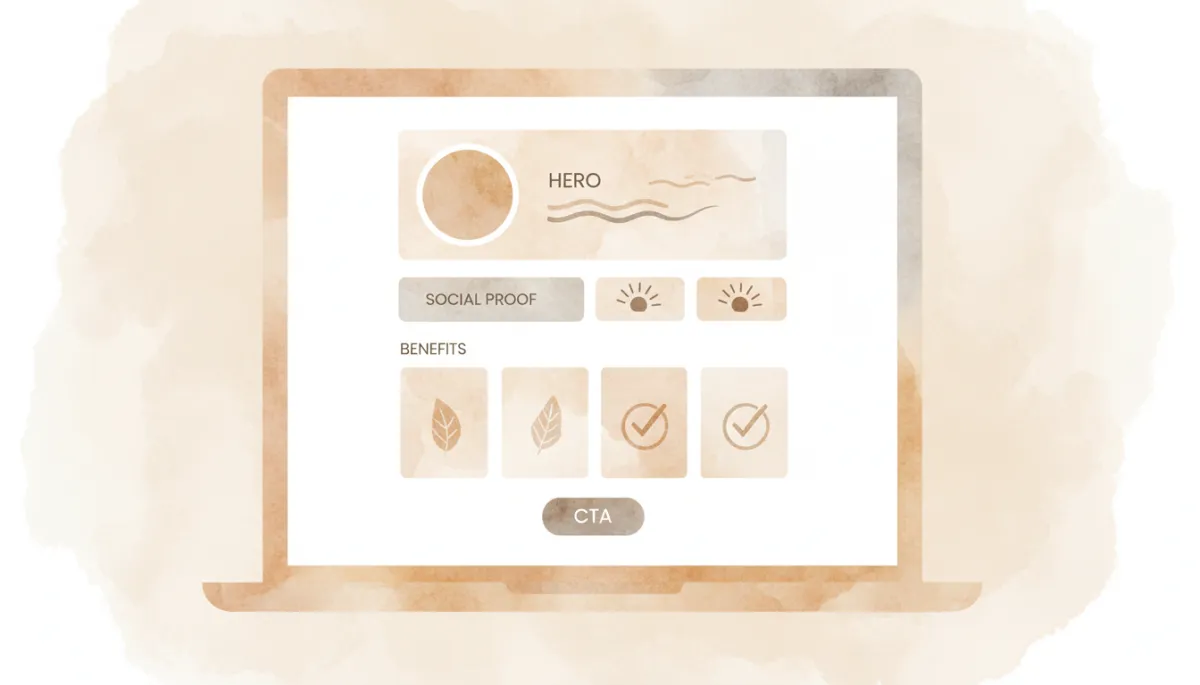
A clear, repeatable homepage structure outperforms clever design experiments every time.
Structure every key page like a landing page
One of the biggest missed opportunities is treating “Services” or “About” pages as afterthoughts. In reality, these are decision pages. Each one should behave like a focused landing page:
Single core goal (enquiry, demo, download, call booking)
Specific audience (don’t write one page for everyone)
Clear structure: outcome, proof, process, FAQs, CTA
From a search perspective, this supports intent-based optimisation. Someone searching “high converting website structure” wants a practical guide and likely a partner to implement it. That’s why we recommend internal links from this type of article to pages like “website conversion optimisation services” or a “WebEngine-powered site demo”.
Performance and UX: the conversion killers
Even the best structure fails if the site is slow or clunky. Current best practice targets an Interaction to Next Paint (INP) of 200ms or less and Largest Contentful Paint (LCP) under 2.5 seconds. That’s not a “nice to have”. It’s a ranking factor and a trust factor.
WebEngine is built on a modern, server-first architecture that bakes these performance standards into the stack: server-side rendering, edge caching, and image optimisation as standard. Instead of asking your team to wrestle with technical SEO, you get a platform that pushes your pages toward Core Web Vitals benchmarks while you focus on messaging and offers.
💡 Pro Tip: Treat speed, accessibility, and mobile UX as conversion levers, not technical chores. They directly affect how many visitors stick around long enough to convert.
A slightly contrarian view: don’t over-personalise too soon
Personalisation, chatbots, and AI recommendations are powerful, and they’re absolutely part of high-converting websites in 2026. However, if the core structure is weak, layering AI on top just helps people get lost faster.
We see better results when businesses:
Nail the fundamentals first (navigation, page hierarchy, messaging, CTAs)
Then use tools to test and modular components to A/B test hero sections, forms, and offers
In other words: structure first, sophistication second. That’s how you get compounding gains rather than shiny-but-fragile experiments.
Bringing it together with WebEngine
A high-converting website in 2026 is built on three pillars:
Strategic structure: clear hierarchy, focused landing pages, strong internal linking
Modern UX: mobile-first design, visual hierarchy, accessibility, and trust signals
Technical performance: Core Web Vitals, SEO-ready architecture, and scalability
WebEngine is designed to sit underneath that strategy and make it sustainable. You get:
Structured page templates aligned with best-practice layouts
Clean, SEO-friendly URL structures and internal linking controls
Built-in performance optimisation, accessibility features, and analytics hooks
Next steps: turn structure into revenue
If you take one thing away from this, let it be this: your website doesn’t need more pages, it needs better structure. Map your key journeys, tighten your page layouts, and make every click a step toward a conversion.
From there, a platform like WebEngine gives you the technical edge. Fast, scalable, and built around the way high-converting websites actually work today. If you’d like to see how your current structure stacks up, start with a simple audit and then explore a WebEngine-powered site walkthrough to see what’s possible.
The structure is the strategy. Get that right, and every campaign you run will perform better on day one.